


Happy Monday. 👋
Welcome back to another edition of The Grumpy Optimists. I took the week off last week to enjoy the Easter longer weekend and refresh my mind and body. I feel great for doing so, there might be something in this four day work week hey?
Before we get into positive news for the week, I’d love to remind you all I’m hosting a free event on the 7th of May in central London at the fantastic Lucky Saint pub. The event will be based on bringing people who care about the planet together to talk about how we can imagine a better future.
There’s only 40 places available and the last poll I did had a great response, so please request a ticket below. I’d love to meet some of you in person!
There’s a lot about energy and nature this week so I’ve separated them out. I’ve also got an incredible read for you as you head into the week.
⚡ The numbers are moving
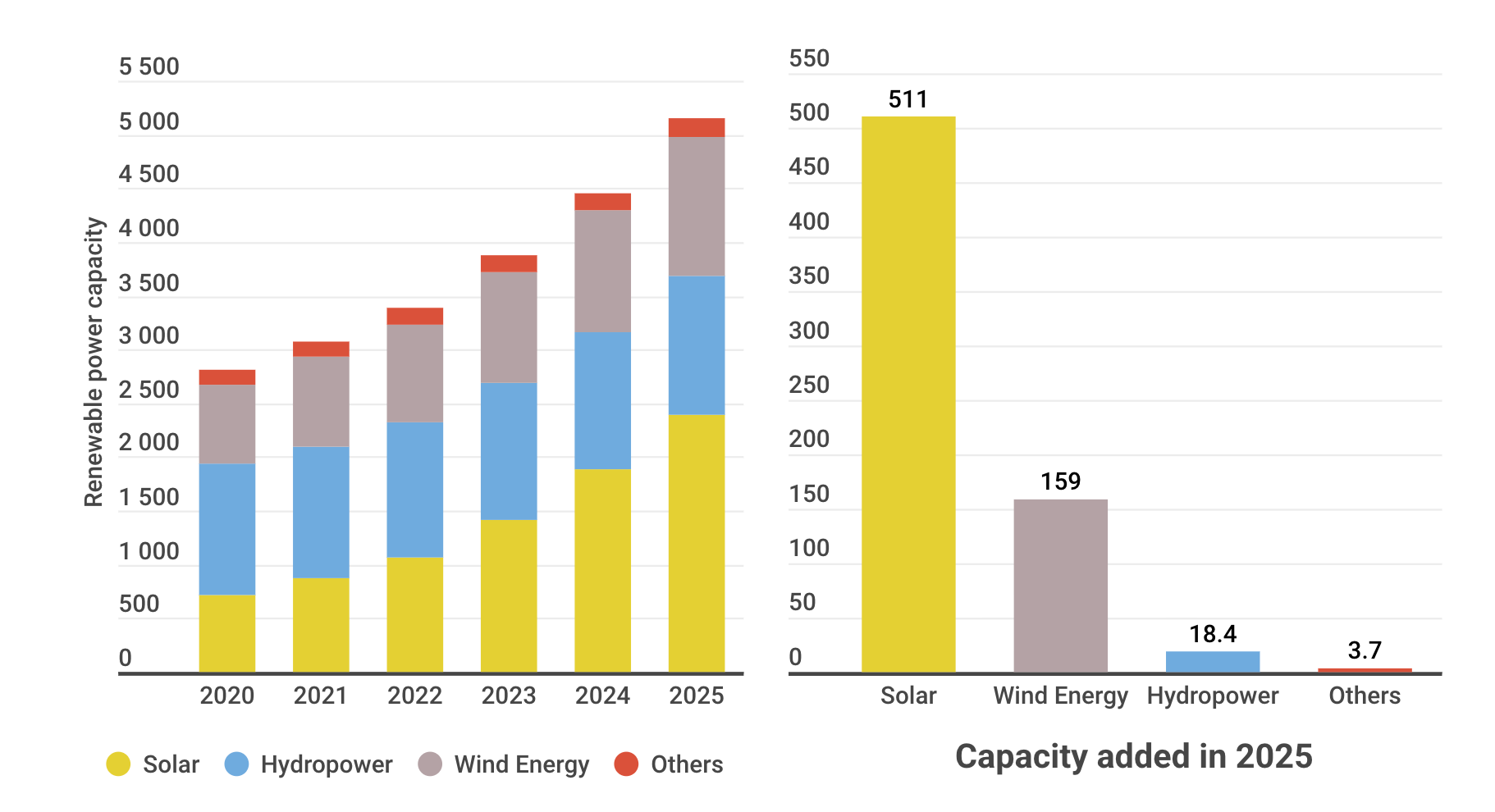
🌍 Record 692 GW of renewables added globally in 2025. The International Renewable Energy Agency (IRENA) yearly report shows a 15.5% increase in renewable energy in 2025, adding 692 gigawatts (GW) of capacity and 85.6% of the total global power added in 2025. That puts global renewable capacity at 5,149 GW, accounting for nearly half of all global power capacity at the end of 2025.
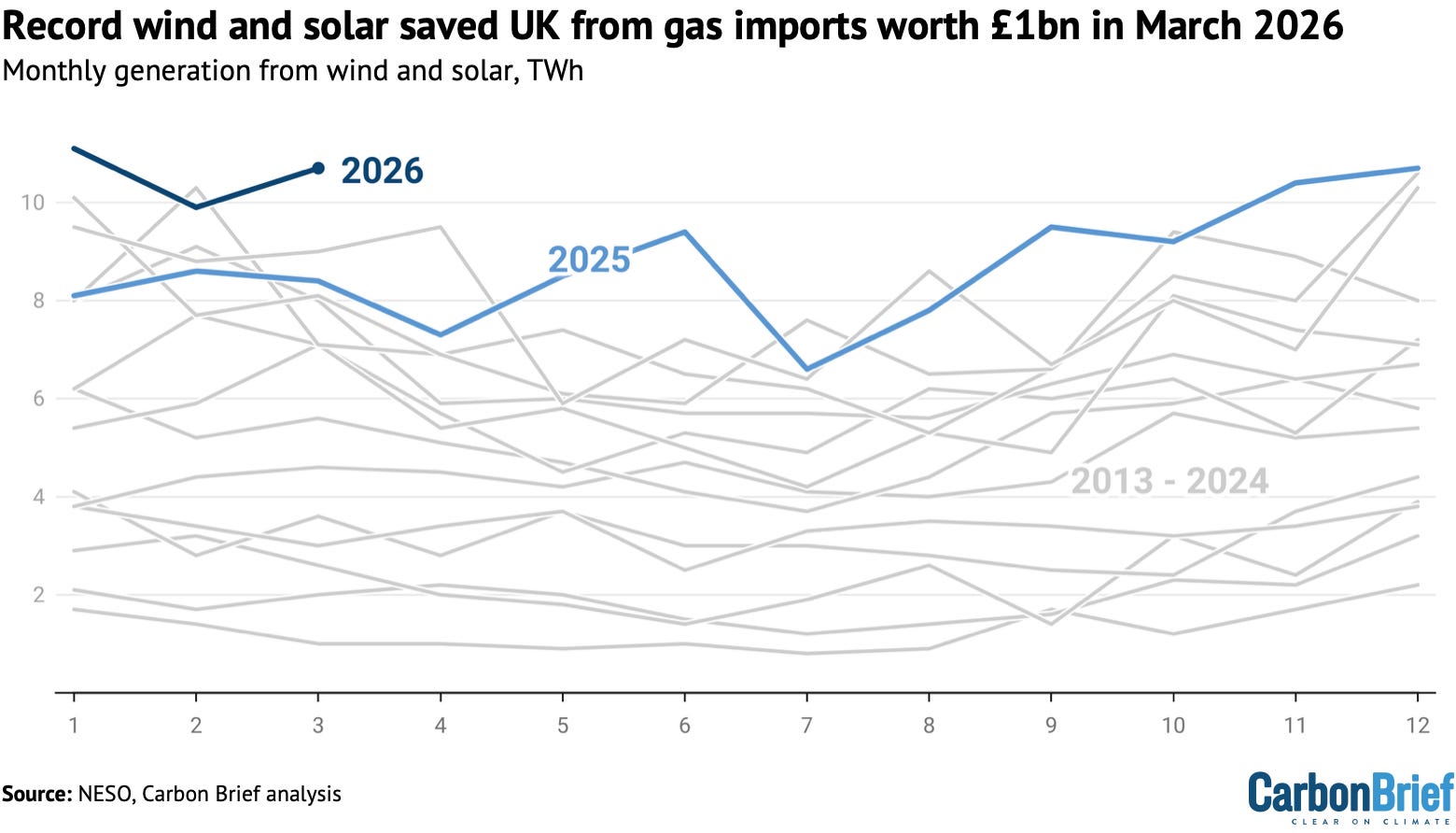
🇬🇧 UK wind and solar saved Britain £1bn in gas imports in a single month. Carbon Brief analysis shows March 2026 was a record month for combined wind and solar on the British grid, up 28% year-on-year. Wind generation alone rose 38%, pushing gas output to its lowest March level ever recorded. At Iran-war-inflated prices, that avoided generation equated to roughly 18 fully loaded LNG tankers.
💭 My thoughts? The framing of renewables as an energy security play rather than a climate one is doing a lot of heavy lifting right now. Politicians who spent years blocking wind farms are suddenly very interested in domestic generation. Cynical? Maybe. But if it gets turbines in the ground, I’ll take it.
🇮🇳 India’s CO2 emissions grew at their slowest rate in two decades in 2025. Just 0.7% growth, down from 4-11% in the preceding four years. Power sector emissions actually fell 3.8%, the first drop outside Covid since 1973, driven by a year in which India added 47 GW of solar and 6.3 GW of wind. The contradictions remain: the country is also planning massive coal, steel and cement expansion. But the direction of travel in power is striking.
🇪🇺 IMF says France and Spain are structurally well-positioned for the energy transition. A March 2026 IMF working paper highlights Spain as a case study in what early bets on renewables deliver: 56% renewable electricity share, with Spain’s central bank crediting the grid shift for a 40% reduction in electricity prices. France’s low-carbon nuclear base provides a different but complementary structural advantage. The IMF estimates the transition requires sustained investment of 2-3% of EU GDP annually.
⚡ 97% of business leaders now support the shift to renewables. The We Mean Business Coalition’s latest survey finds near-unanimous corporate backing for the energy transition, driven overwhelmingly by energy security, risk reduction, and financial returns rather than climate commitments. Worth noting: this isn’t the usual suspects. It’s a broad cross-sector coalition. When the economics start doing the talking, the conversation changes pretty fast.
☀️ Government approves UK’s largest ever solar farm. The 800MW Springwell Solar Farm in Lincolnshire got the green light on April 8, covering an area equivalent to 1,700 football pitches and expected to power over 180,000 homes a year. It’s the 25th nationally significant clean energy project approved since July 2024. We need to say no to NIMBYs more in this country.
🐦 Nature doing its thing
🌱 Nature loss is now a business and security risk, not just an environmental one. The UK government’s latest Nature Markets Framework makes this shift explicit: private investment, biodiversity net gain, and land use planning are now being treated as economic infrastructure, not green afterthoughts. The framing has changed. Nature is no longer just something to protect at the margins of a planning document. It’s a systemic risk that finance and business are being asked to price in.
🦒 40 migratory species gain new global protections, as giraffe numbers quietly rise 20%. The UN’s migratory species conference wrapped in Campo Grande, Brazil on March 29, adding cheetahs, snowy owls, giant otters and thresher sharks to protected lists, alongside new action plans for jaguars and Amazon catfish. Buried in the proceedings: combined giraffe populations rose from 113,000 to 140,000 between 2020 and 2025, attributed directly to previous coordinated actions under the same convention. BirdLife called the bird outcomes a “major breakthrough.”
🌊 10% of the world’s ocean is now officially protected. IUCN announced this week that 10.01% of the ocean is now within designated protected and conserved areas, a milestone six years late under the old Aichi targets but a milestone nonetheless. Over the past two years, an area larger than the European Union has been brought under protection. The honest caveat from IUCN themselves: coverage still needs to triple by 2030, and most existing MPAs are not actively managed.
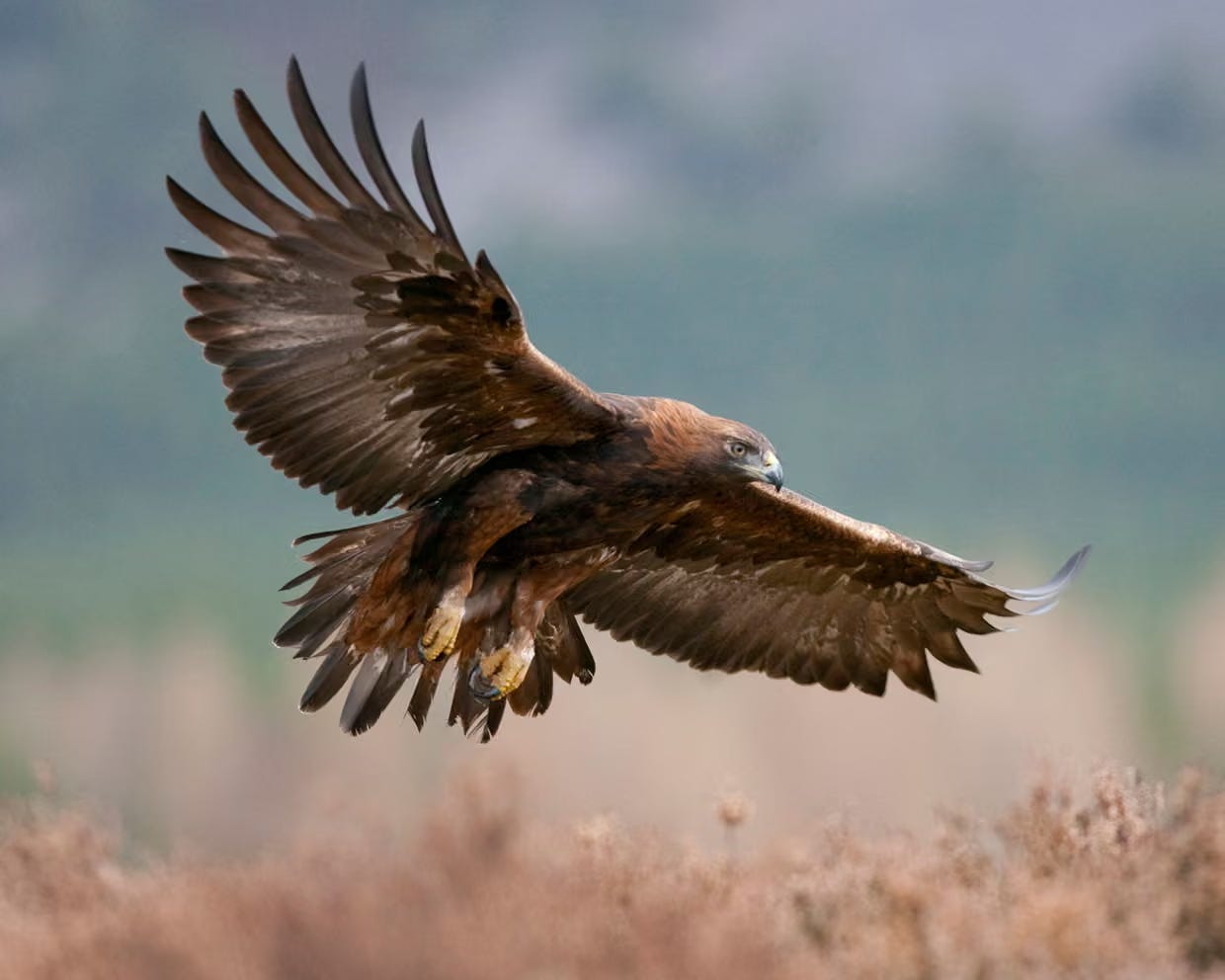
🦅 Golden eagles set to return to England for the first time in 150 years. A Forestry England feasibility study published today identifies eight potential recovery zones in northern England capable of sustaining golden eagle populations. The government has backed it with £1m in funding, and juvenile birds could be released as early as next year. The species was wiped out in England during the Victorian era, with the last individual dying in the Lake District in 2016. In southern Scotland, conservation work has already boosted numbers to record levels, and satellite tracking shows young birds are already exploring northern England on their own.
🎧 This week's recommendations
I have two recommendations for you this week.
🎵 I really want my music recommendation to be Justin Bieber at Coachella, but instead I’ll give a banger from 2012, I Need by Maverick Sabre.
📚 My reading recommendation for the week is a beautiful, beautiful article about how everything is a win when the goal is to experience. I’ve sent this to about 10 people this week and it’s beautiful.
Have a great one, George, the Grumpy Optimist 💚