


Happy Monday. 👋
Welcome to this week’s edition of The Grumpy Optimists. This time, not only are we looking at some positive news, but we’re also recapping the event I hosted last week.
There’s a lot to cover, so let’s dig in.
🗺️ The Grumpy Optimists Event Recap
Last Thursday I hosted a Grumpy Optimists event at the Lucky Saint pub. While there were drinks flowing and great conversations, I also made everyone participate in a bit of organised fun, writing about the future.
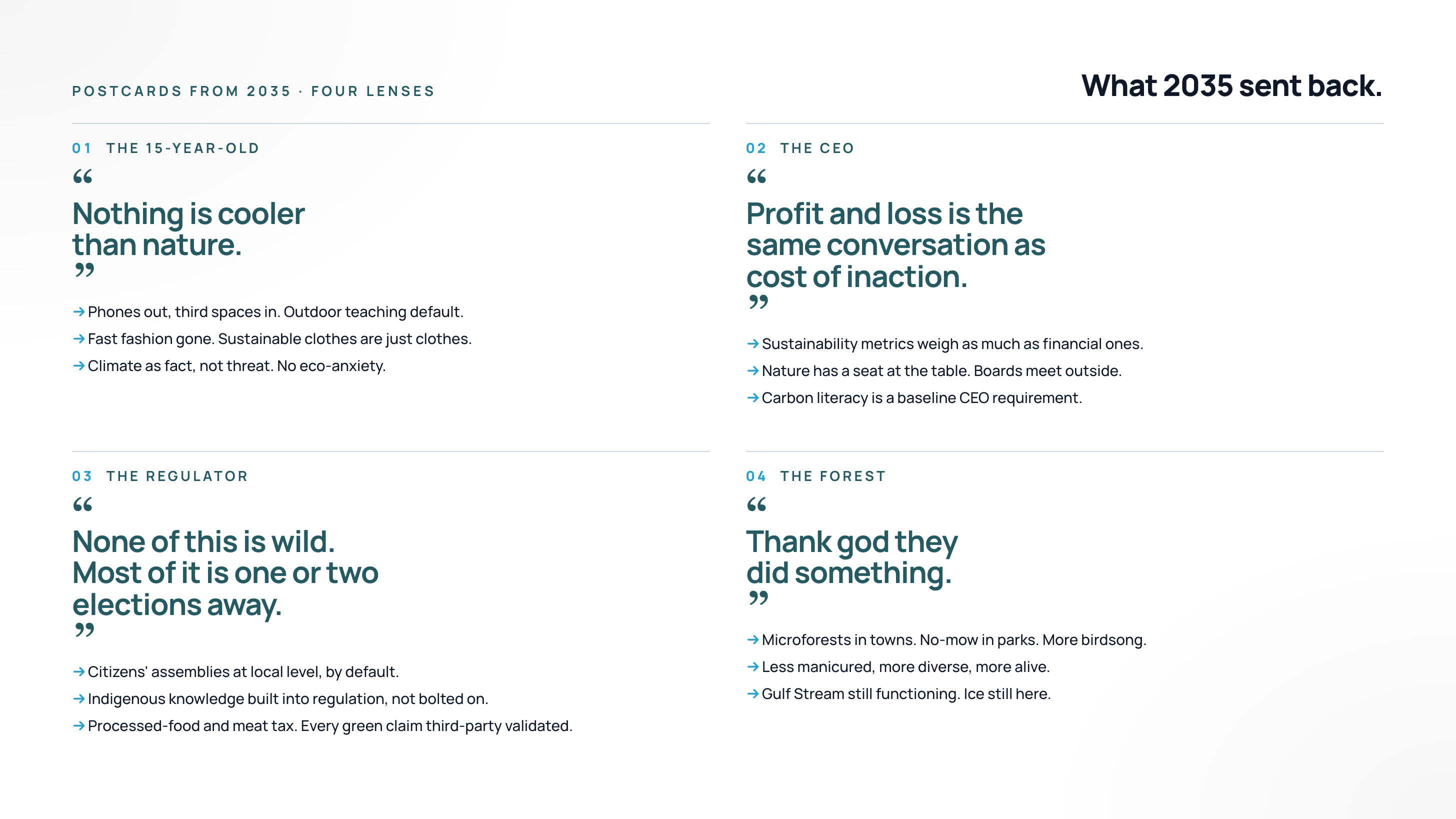
The premise was simple: forget 2026 for two hours and time travel to 2035 as an optimist. We looked at the world through 4 lenses: a 15-year-old, a CEO, a regulator, and nature itself. The conversations were fantastic, the energy delightful and the ideas inspiring. I thought it would be a shame to not share them with you.
Let’s look at what the scribbles, words and drawings made.
🛹 The 15-year-old
The 15-year-old in 2035 is outside. Phones are out, third spaces are in. Youth clubs are back and somehow cool again. Allotments are normal. Classrooms have “nature + climate” written on the door, outdoor teaching is the default, and the kids are less stressed and learning better for it.
Fast fashion is gone. Seasonal eating is normal. Sustainable clothes are just clothes.
The phrase that stuck with me was “no eco-anxiety”. A generation that grew up with climate as fact, not threat. That’s a different kind of childhood from the one I’d imagined a few years ago.
Best line on this page: “Nothing is cooler than nature.”
🏢 The CEO
The 2035 boardroom looks nothing like the one I sit in today. Sustainability metrics carry the same weight as financial ones in performance reviews. Nature has a seat at the table. Board meetings happen outside. Carbon and nature literacy is a baseline CEO requirement, not an optional add-on.
“Profit and loss is the same conversation as cost of inaction.” Patagonia-style 1% of profits to charity is normal. Customers expect supply chain transparency, and companies provide it. Solar and ground-source heat pumps stopped being sustainability stories and became how you keep energy costs down.
One person wrote “Paul Polman Junior x 100,000”. For those of you who don’t know, he was the CEO of Unilever who really pushed for the climate agenda in the 2010s. A hero.
I loved this one as it’s all I try to do with my work at Zevero.
🏛️ The regulator
This was the most detailed page of the night.
I loved the ideas of citizens’ assemblies operating at the local level by default. Indigenous voices and ancestral knowledge are built into regulation, not bolted on as a consultation step. Farmers are given a seat at the regulatory table to help change how we grow food. A just transition that comes from the shop floor up, not the boardroom down.
The new laws went deep. A processed food and meat tax. Mandatory food waste reporting, an end to deforestation and palm oil. Mental health and nature days as standard for every business. Every green claim third-party validated with data and tax that scales with emissions.
None of this is really that wild, it’s just about whether we actually care enough to put it into action.
🌳 The forest
If a forest could write a postcard back to 2026, this is what it said: “Thank god they did something.”
The forest of 2035 is in the city, it’s microforests in towns, no-mow in parks. We create a less manicured, more diverse and more alive interaction between humans and nature. More birdsong, more pollinators and more seaweed farming came up too. Fewer cows where they shouldn’t be, often destroying grassland.
One drawing had the Gulf Stream still functioning, with “ICE STILL HERE” written underneath.
🧵 Cross-cutting themes
Five things came up on more than one page, which feels significant.
Nature gets a literal seat at the table. Boardroom, council, regulator. This was the single most repeated image of the night. This is already happening with brands like Faith in Nature.
Decentralisation. Power flows down to councils, communities, streets, allotments, classrooms to make change.
Education as infrastructure. Carbon and nature literacy mandatory at every level, from the CEO to the 15-year-old knowing about climate.
The end of greenwashing. Third-party validation, supply chain transparency, mandatory reporting.
Letting go. Fast fashion, palm oil, processed food defaults, eco-anxiety. This is the shift from assuming humans are extractors rather than stewards of the world.
Overall, the event was incredible. I’m grateful for those who came and I look forward to hosting the next one…you’re all invited.


👀 News to make you feel good
🌍 New signs the Iran war is boosting clean energy. Axios pulled together early signals from China, South Korea and the EU showing the war is accelerating the energy transition globally. South Korean EV sales more than doubled in March year on year, solar panel imports were up 137%, and EU leaders say they will get more aggressive on electrification because the war made it expensive not to.
🇪🇺 European rooftop solar demand has doubled since the war began. Octopus Energy reports UK heat pump sales up 51% and solar up 54% in three weeks of March. OVO Energy’s April sales in solar and heating were ten times higher than a year earlier. Enpal’s CEO Mario Kohle summed it up: “This is about European resilience.”
🇳🇱 Amsterdam becomes the first capital city to ban meat and fossil fuel adverts. Since 1 May, billboards, tram shelters and metro stations have been stripped of ads for petrol cars, airlines, cruises, beef, chicken, pork and fish. The BBC describes one busy tram stop where the chicken nuggets and SUVs have been replaced with a poster for the Rijksmuseum and a piano concert. Edinburgh, Sheffield, Stockholm and Florence are moving the same way, and France has it nationwide.
💭 My thoughts? Lawyer Hannah Prins calls this a deliberate “tobacco moment” for high-carbon food. The smoking ban felt impossible until it didn’t. The norm is shifting.
🛢️ Can we loosen the grip fossil fuels have on our lives? According to the IEA, chemicals derived from oil and gas make up 90% of all raw materials, with petrochemicals accounting for 14% of oil demand. The Guardian walks through realistic alternatives across the big three of fertilisers, plastics and textiles: green ammonia, seaweed-based bioplastics, natural fibres. As Cip Hamilton at the Australian Marine Conservation Society puts it: “We cannot recycle our way out of a crisis driven by overproduction.”
🐟 Ghana declares its first ever Marine Protected Area. 703 square kilometres off the Greater Cape Three Points coast, covering critical fish breeding grounds and coastal wetlands, after 15 years of advocacy led by Ghanaian NGO Hen Mpoano. A community-led MPA pulling Ghana closer to the global 30x30 goal, despite USAID funding cuts last year that nearly derailed the project.
This episode was written after a soul-charging weekend in Lewes, lots of time in nature and an appreciation for life. My music recommendation for this week is Better (Solace) by Mantra, a real pick me up song.
See you next week!
George, the Grumpy Optimist 💚