


Happy Monday. 👋
Welcome back to another edition of the Grumpy Optimists. This week there’s no event to recap or insights from fellow Grumpy Optimists, but there is plenty of great news from around the world.
Let’s dig into it!
👀 News to make you feel good
🐟 Dutch court rules bottom trawling in the Dogger Bank is unlawful. The District Court of The Hague has ruled that Dutch bottom trawlers can no longer fish the country’s largest marine protected area without a permit and a full environmental assessment. It is the first known European ruling to confirm that governments have a legal duty to regulate trawling’s impact on offshore Marine Protected Areas. The case was brought by Doggerland Foundation, ARK Rewilding Nederland, ClientEarth and Blue Marine Foundation, and they’re already pushing the EU and UK to apply the same logic.
💭 My thoughts? The phrase that keeps coming up in the coverage is “protected means protected”. For two decades, MPA has been more of a polite label than a legal constraint. This ruling makes it a constraint. It’s pretty mental we’ve got to this point, surely?
☀️ India’s top solar state blocks a 3.2 GW coal project for a second time. Rajasthan’s electricity regulator has refused, again, to approve a 25-year coal contract sought by the state utility. The reasoning is simple: the state’s own resource plan only needs 1,905 MW of additional coal capacity by 2035-36, far less than the 3,200 MW sought, and a plant that size would have burned 40,000 tonnes of coal a day. While other Indian states are locking in long coal contracts, Rajasthan is betting that solar, batteries and a bit of nuclear will get there first.
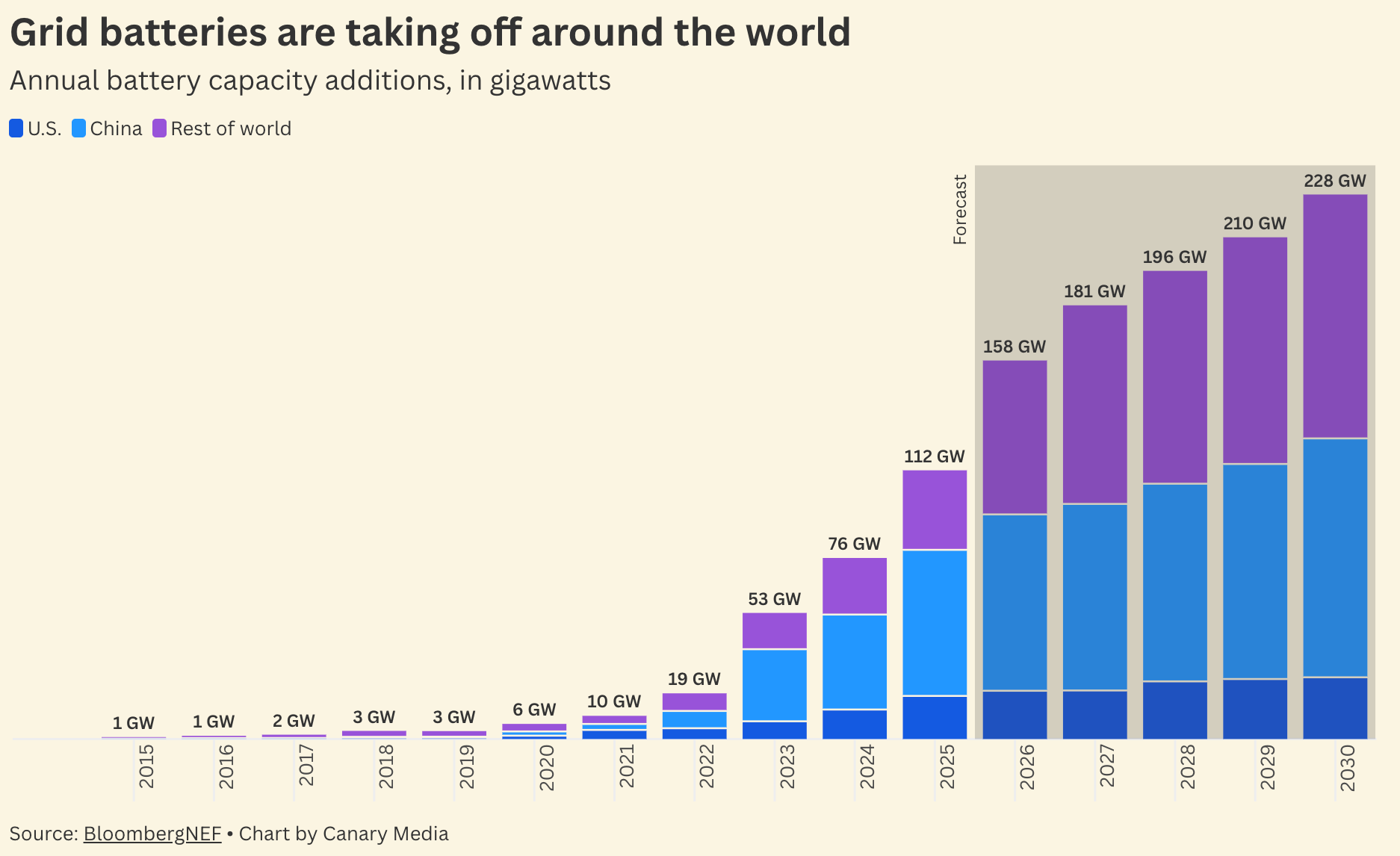
🔋 The world is installing grid batteries at a blistering pace. 112 gigawatts of grid battery storage went in worldwide in 2025, up 48% on 2024 and ten times the level installed in 2021. BNEF forecasts another 158 GW in 2026. To borrow Canary’s framing: first came the solar, now the batteries have arrived.
💭 My thoughts? For years the stock objection to renewables was “fine, but what about when the sun doesn’t shine”. The infrastructure to answer that question is now being built faster than almost anyone forecast five years ago. The interesting bottleneck has moved from generation to dispatch, and even that is closing fast.
🧱 Basalt could be the key to greener and cheaper cement. Researchers at UC Santa Barbara and Brimstone Energy have shown that swapping limestone for basalt could cut cement emissions by 25% on average grid electricity, and up to 80% in theory. Cement is around 4.4% of global emissions, and most of those come from the chemistry of heating limestone, not the energy used to do it. Basalt has no embedded carbon, and there’s enough of it near the surface to supply global cement production for hundreds of thousands of years. The output is still standard Portland cement, so it drops into the existing supply chain.
🚛 Electric trucks are taking off in China. Electric trucks now make up 20% of new commercial vehicle sales in China after sales tripled in 2025, with monthly sales hitting 24,000 in March. Diesel is up 35% and LNG up 53% since the Iran war began, Bloomberg reports payback on the higher upfront cost is now as little as a year. The math now makes sense.
🌫️ Coal pollution is cutting solar power output worldwide. New research from Oxford and UCL, published in Nature Sustainability, mapped 140,000 solar PV installations and found that aerosols from coal-fired power plants reduced global solar output by 5.8% in 2023. That’s 111 terawatt-hours of lost generation, equivalent to the annual output of 18 medium-sized coal plants. The losses run at about 74 TWh a year, roughly a third of the annual gains from new solar capacity. Not so happy, but it shows the knock on impact.
🏝️ Australian solar company signs deal to help “entire country” quit diesel. Sydney’s Smart Commercial Energy has signed an MOU with the small Pacific island state of Nauru for 18 MW of solar and 40 MWh of battery storage. Nauru currently burns around 8 million litres of imported diesel a year to power 13,000 people, with all the cost and emissions that implies. The Pacific islands most exposed to sea level rise are also the places paying the highest premium for fossil power. I love this story.
⛏️ A former Scottish colliery is being turned into a solar and battery hub. The National Mining Museum Scotland, on a site that closed in 1981 and is now one of the best preserved Victorian-era collieries in Europe, is installing around 100 kW of solar and a lithium-ion battery the size of a small shipping container. Excess generation will be exported to the grid as a revenue stream to help secure the museum’s future. They’re crowdfunding £450,000 to make it happen.
This episode was written after the joy of Leeds United winning in the 95th minute on Sunday. What a day. Today’s song choice is White Flag by Dido. See you next week!
George, the Grumpy Optimist 💚