


Happy Monday. 👋
Welcome back to another edition of The Grumpy Optimists.
This week I posted something relatively personal on my LinkedIn that I wanted to share here too. The short version: as a northerner, I always assumed working with a coach was for people with too much time on their hands. I was wrong. Five and a half years of building Zevero, plus some therapy and sertraline along the way, taught me that growing and improving yourself isn’t cringey, it’s powerful. Big shout-out to Caspar Chittenden, who’s been helping me figure out what my thirties should actually look like.
The good news is that things like this blog bring me a lot of purpose, so I’m very grateful for you all reading this.
👀 News to make you feel good this week
🌍 For the first time ever, wind and solar generated more electricity than gas worldwide. In April, wind and solar produced 22% of the world’s electricity against gas’s 20%, a record 531 TWh versus 477 TWh. Five years ago gas generation was almost identical to today’s, but wind and solar produced less than half what they do now. New demand is being met by renewables which is great.
🔋 Australian power bills are set to fall by up to 10%, and renewables get the credit. The regulator’s final Default Market Offer means households across NSW, South Australia and southeast Queensland will pay less from July, with small businesses seeing drops of up to 20%. Energy Minister Chris Bowen put it down to a grid that’s now half renewable and more than 400,000 home batteries installed since last July. How can we get these benefits for the rest of the world?
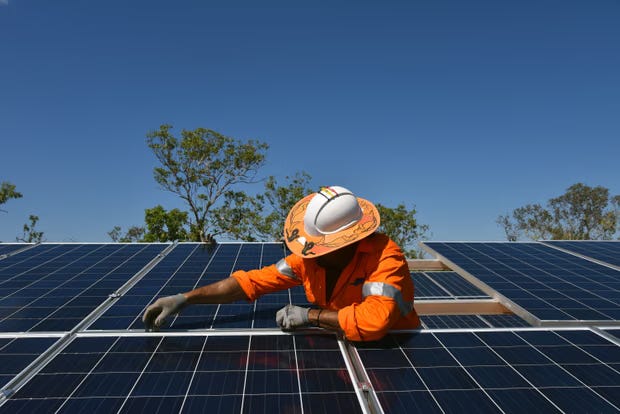
🇵🇰 Pakistan’s solar capacity now nearly matches its entire national grid. Distributed solar hit roughly 38 GW last financial year, about 93% of the country’s utility-scale capacity, generating an estimated 51 TWh, nearly half of all grid electricity sales. Most of it is households, farms and factories who got fed up with sky-high prices and unreliable supply and simply went and bought panels.
💭 My thoughts? What’s cool about this is that it’s less about regulation and policy and more about people doing their own maths and creating change from the bottom up.
🌬️ China installs the world’s largest single-unit floating wind turbine. The 16-megawatt “Three Gorges Pilot” now sits in deep water off Guangdong, built to ride out Category 5 winds and waves over 20 metres. Once fully operational it’s expected to power around 24,000 homes a year (some outlets quote a much lower 4,200 figure, but that’s based on far higher US household consumption). Floating turbines matter because they unlock the deep water where the strongest, steadiest winds actually are.
📋 The SBTi has rewritten its entire 2026-2030 strategy, shifting from “ambition-setter” to “transformation partner”. I wrote about this on LinkedIn during the week. The short version, the standard-setter that’s spent a decade getting 13,000+ companies to set targets is now pivoting to help them actually deliver on them, with sector-specific approaches and a real change to how firms are treated when they miss. Setting the goal was always the easy part. This is the harder, more interesting chapter.
🌲 Deforestation in the Brazilian Amazon fell to its lowest level since 2019. Brazil lost 20.6% less native vegetation last year, with Amazon deforestation down 23.5%, which MapBiomas credits to a real increase in enforcement and sanctions. It’s not a clean win, though: five trees a second are still being felled, and the Cerrado savanna alone accounted for more than half the total loss. Progress and a long way to go, in the same sentence.
🐦 Forever chemicals in seabird eggs have plummeted by up to 74%, and it’s because regulation worked. A 55-year study of northern gannet eggs in Canada tracked PFAS rising to a peak around 2000, then falling sharply once phaseouts and bans kicked in. The researchers’ own words: “The regulations are having a good effect.”
💭 My thoughts? We’re so used to the forever-chemicals story being relentlessly bleak that it’s easy to miss the actual headline here, which is that we banned something nasty and the planet responded. The persistence of PFAS is real and the industry has already moved to newer compounds we can’t track as easily. But the principle holds, policy works, and you can watch it work its way up the food chain.
And one to keep us honest
🌾 Experts warn Britain is “sleepwalking into a food crisis”. Nine food experts, led by Tim Lang, wrote to ministers warning that extreme weather, inflation and global instability add up to a national security risk the government isn’t taking seriously. Food prices are on track to be 50% higher this November than five years ago, and the current heatwave is hammering yields after a dry spring. For those of you not in the UK, my visit to the supermarket last week was stopped by the fridges and freezers breaking from the heatwave we experienced. Wild.
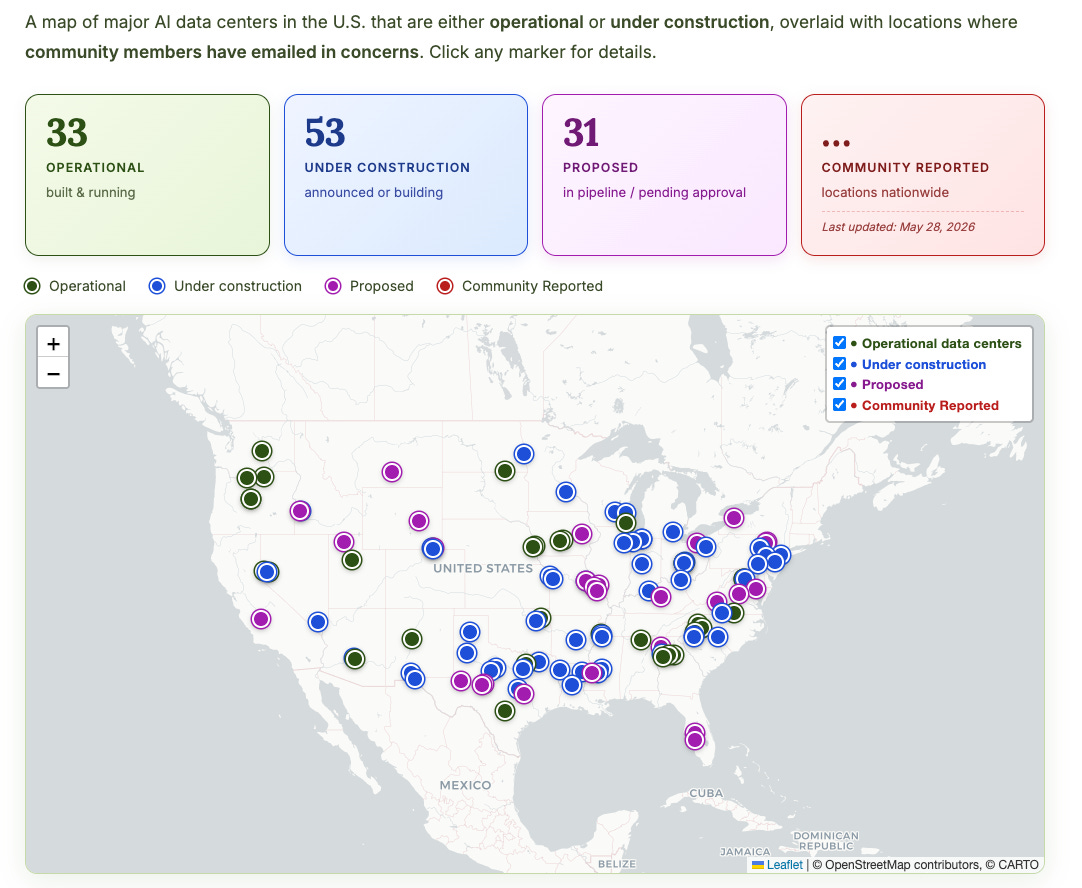
🗺️ Erin Brockovich has built a crowdsourced map of every major AI data centre in America. Yes, that Erin Brockovich who fought for protecting water in California. Her site tracks AI data centres that are operational, under construction or merely proposed, then overlays them with concerns emailed in by residents living next to them: the energy draw, the water for cooling, the e-waste, the constant hum.
💭 My thoughts? The AI boom is real and largely unstoppable, but where it gets built, how much water it drinks and who carries the cost are still very much up for grabs. I’m very pro AI, but I do believe we have to build infrastructure with purpose so this is a really great piece of work. The slight irony is that the website was clearly built using AI.
This week’s edition was written after a slightly hungover Sunday but a great weekend of exercise and good times. This week I’ve been listening to a BUNT remix of Temper Trap, Sweet Disposition.
George, the Grumpy Optimist 💚